



Dental Implants Cincinnati & Crescent Springs
What are dental implants?
A natural tooth consists of a root and a crown. If you compare natural teeth to implant-supported replacement teeth, you’ll see they have the same basic parts. Both have a crown (the visible part used to chew food). Both have a root that holds the tooth securely under the gum and is anchored into the jaw. The difference is that the implant is made of titanium – the same time-tested material used by surgeons for artificial joints. When you lose a tooth, you lose both the root and the crown. To replace the tooth, the surgeon first replaces the root with a dental implant.
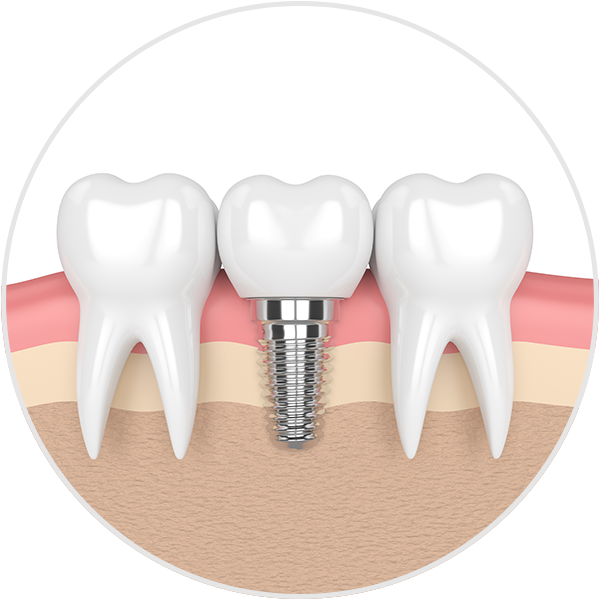
Time is allowed for bone to heal and grow around the dental implant. The bone bonds with the titanium, creating a strong foundation for artificial teeth. A support post (abutment) is then placed on the implant and a new replacement tooth (crown) is placed on top of the abutment. If all of your teeth are missing, a variety of treatment options are available to support the replacement teeth.
Dental implants make it possible to renew your smile if you have lost some teeth. There are several options when it comes to dental implants, depending on how many teeth need to be replaced: just one tooth or several teeth in a row.
An ideal candidate for dental implants:
- Is a non-smoker
- Has maintained good oral health
- Has healthy gums with no signs of gum disease
Single or Multiple Dental Implants
Dental implants are very versatile. If you’re missing one tooth, one implant and one replacement tooth will take care of your problem. If you’re missing several teeth in a row, a few strategically placed implants can support a permanent bridge. Similarly, if you have lost all of your teeth, a full bridge or full denture can be permanently fixed in your mouth with a strategic number of implants.
Dental Implants vs. Dentures and Bridges
Unlike dental implants, bridges and dentures are not fixed to the bone. This can result in them being unstable, making it difficult to eat or smile with the confidence you want. Dental implants look, feel, and act more natural, just like your natural teeth. They also have a stronger biting force. Implants do not rely on neighboring teeth for support, which is definitely an advantage since this means they won’t compromise the health of your surrounding healthy teeth. Implants are also likely to last a lifetime, whereas bridges are only expected to last seven to ten years and even less if a root canal is required.
How long will the implants last?
Implants usually last a long time. When patients are missing all of their teeth, long-term studies (more than 30 years) show an 80 to 90 percent success rate. For patients missing one or several teeth, recent studies show a success rate of greater than 95 percent, which compares favorably with other areas in the body that receive implant replacement (such as hips or knees). However, if one of your dental implants either doesn’t heal properly or loosens after a period of time, you may need to have it removed. After the site heals (or on occasion at the time of removal), another implant usually can be placed.
Ready to Make an Appointment with Dr. Stigall?
Call Implants and Orofacial Surgery Specialists with any questions or to make an appointment!