



Bone Grafting Cincinnati & Crescent Springs
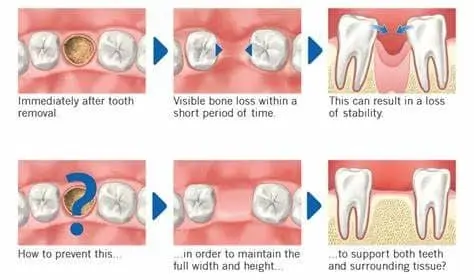
Over a period of time, the jaw bone associated with missing teeth atrophies and is reabsorbed. This often leaves a condition in which there is poor quality and quantity of bone suitable for the placement of dental implants.
Bone grafting is a surgical procedure where bone particles are placed to provide structural stability and generate new bone growth that was lost or diseased. These bone particles can come from you, a donor, or be synthetic. The graft acts as a stimulus for your own body to regenerate bone in areas where it has been lost. Once normal bone cell turnover occurs the graft becomes your bodies own bone which allows the strength to place an implant.
Bone Grafting is possible because bone tissue has the ability to regenerate when provided the space into which to grow. Osteoconduction and osseinduction occur when bone graft material stimulates the bodies natural bone cells. Dr. Stigall uses a number of grafting materials and membranes. These can be used for a number of clinical indications including sinus floor elevation, socket preservation, ridge augmentation and periodontal defects. Dr. Stigall will choose the appropriate allograft for each patients’ indication and/or personal preference. Mineralized/demineralized bone is a unique blend of 70% mineralized and 30% demineralized cortical bone, thus combining the key benefits of each graft material in ONE PRODUCT! A great mix between strong structural support and fast bone formation. Mineralized cancellous bone has a porous structure that allows revascularization, critical for formation of new bone cells.
Missing teeth over a period of time can cause your jawbone to atrophy or resorb. This often results in poor quality and quantity of bone suitable for the placement of dental implants as well as long-term shifting of remaining teeth and changes to facial structure. Most patients, in these situations, are not candidates for dental implants without some type of bone grafting. Dr. Stigall performs several types of bone grafting procedures.
Ready to Make an Appointment with Dr. Stigall?
Call Implants and Orofacial Surgery Specialists with any questions or to make an appointment!
1.SOCKET PRESERVATION
Bone grafting is indicated for socket preservation. The site of the surgical procedure will be debrided and the bone particles will be placed into the site.
2.RIDGE AUGMENTATION
Dental implants require osseointegration. When a tooth is extracted, the alveolar process begins. Resorption phase lasts around 8 to 10 days and can be longer in patients with periodontal disease because inflammation lasts longer, resorption may override any bone formation and results in a NET LOSS of alveolar bone. A net loss of bone can dramatically affect your treatment plan. Dr. Stigall and his staff want to educate all patients on the significance of socket preservation and make their treatment plan the most optimal and cost effective. Bone grafting is clinically indicated to rebuild the upper and lower ridge to allow enough diameter for implant placement. When teeth have been lost for several months or years, the ridge width is narrowed and lost as the tooth no longer stimulates the alveolus. This width can be regained with grafting treatments. The protective covering dissolves and some particles may migrate into your mouth. Once healing is complete, 10 weeks or more, then the implants are placed.

3. SINUS FLOOR AUGMENTATION (sinus lift)
“a surgical procedure which aims to increase the amount of bone in the posterior maxilla (upper jaw bone), by lifting the sinus membrane and placing bone.” This allows the implant to have more bone to support your prosthesis. There are two ways to perform a sinus floor augmentation and you and Dr. Stigall will determine your plan of treatment.
Bone grafting is indicated for sinus augmentation. When posterior maxillary teeth are lost the hollow space in the cheek, maxillary sinus, may not leave enough bone for implant placement. By raising the membrane that is within the sinus, the lift, new bone height can be achieved. Multiple approaches can be used for the procedure and healing time may vary depending on the severity of deficit. But when complete, the implants are once again placed.
a. LATERAL SINUS LIFT

b. VERTICAL SINUS LIFT
